You step off the elevator and the hallway smells: musty, like garbage, like smoke, or just stale. In a Florida condo building, that smell doesn’t stay put. It drifts under doors, into units and onto clothes. Because hallways and lobbies are common areas, the fix usually goes through the association or management, not one owner. Here’s how to figure out what’s going on and who should do what.
Common Causes of Hallway and Building Smells
- Trash rooms and chutes. Bags that break on the way down leave residue on the chute walls and the bin room floor. In the heat, it gets worse fast.
- Hallway carpet. Years of spills, pet accidents, tracked-in rain and humidity build up in carpet and padding. Carpet that was shampooed and didn’t dry quickly can start smelling musty.
- A leak somewhere. A roof leak, a window leak, a unit’s AC drain line, a riser leak or a water heater can wet hallway walls or ceilings. A musty smell that’s stronger near one spot often points to hidden moisture.
- Not enough fresh, dry air. Many older Florida buildings have hallways that are barely cooled, or ventilation that pulls in humid outside air. Warm, damp, still air smells stale.
- Smoke from a unit. Cigarette, cigar or marijuana smoke escapes under doors and through gaps into the hallway, then into other units.
- Cooking, pets and a dead pest. Strong cooking, a unit with too many pets, or a rodent that died in a wall or ceiling can all show up in the hallway first.
Safety first: if it smells like gas or rotten eggs, leave the area, call 911 from outside, and let management know. If it smells like something electrical is burning, call 911.
If You’re an Owner or Renter
- Write down what you notice. When it smells, where it’s strongest, and what it smells like (musty, garbage, smoke). Dates and times help management find the source.
- Report it in writing. Email the property manager or the association. Renters: tell your landlord in writing too. Keep copies.
- Keep it out of your unit. A door sweep and weatherstripping on your front door block a lot of hallway air. Keep your AC running and your filter changed.
- Check your own unit. If your unit smells musty too, look at your AC closet, under sinks and around windows. A leak in your unit, or the one next door, can be part of the problem. More: musty smell in an apartment or condo.
If the smell is a neighbor’s smoke coming into your unit, see how to find the path and stop it. Questions about who’s responsible under your condo documents or lease are best answered by your association, your landlord or an attorney. This article isn’t legal advice.
If You’re on the Board or Manage the Building
- Start with the obvious sources. Clean the trash chute and bin room, and check the chute door seals on every floor.
- Look at the carpet. If it’s old or smells worse after cleaning, the padding may be holding moisture or pet urine. Replacing it is often the real fix.
- Have the hallway air checked. An HVAC contractor can tell you whether the hallways are getting enough cooled, dehumidified air.
- Find any hidden moisture. If the smell is musty, have the walls and ceilings checked near where it’s strongest. Water stains, bubbling paint or soft drywall mean a leak needs to be found and fixed, and any mold handled by a licensed remediator.
How FL Cleanup Can Help
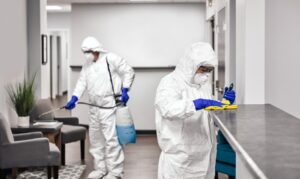
Finding the source: we offer a free infrared inspection, with moisture readings and an infrared camera, which helps spot damp walls and ceilings in hallways and units. If there’s water damage or mold, we handle the drying and licensed remediation, with documentation boards and adjusters can use. More for associations: restoration for condo associations and HOAs and apartment communities.
Inside a unit: once the source is fixed, our whole-home odor treatment clears a smell that’s soaked into a single unit. A unit is priced like a house: $997 including one AC system, plus $550 for each extra AC system. Everyone, including pets, is out for about 8 hours. It’s an odor treatment only.
Hallways, lobbies and other common areas: people walk through them all day, so we don’t use the whole-home treatment there; a building or its common areas need a different type of treatment. Call us and we’ll walk you through the options.
We work with condo owners and associations across South Florida, including Boca Raton, West Palm Beach, Delray Beach and the rest of Palm Beach County. We answer 24/7; when you call, we’ll tell you honestly when a technician can be there based on that day’s schedule. Hablamos español.
About the author: James Rice-Peña founded FL Cleanup, a family-owned restoration company serving South Florida since 2016. He has worked in property restoration since 2012, is IICRC certified, and is a licensed Florida Mold Assessor (MRSA4035) and Mold Remediator (MRSR4158). FL Cleanup has 200+ five-star Google reviews. Meet the team.